Reading journal · Book review
Winter Solstice
Rosamunde Pilcher’s quiet masterclass in unhurried storytelling, ordinary lives, grief, kindness and the emotional power of one perfectly chosen word.
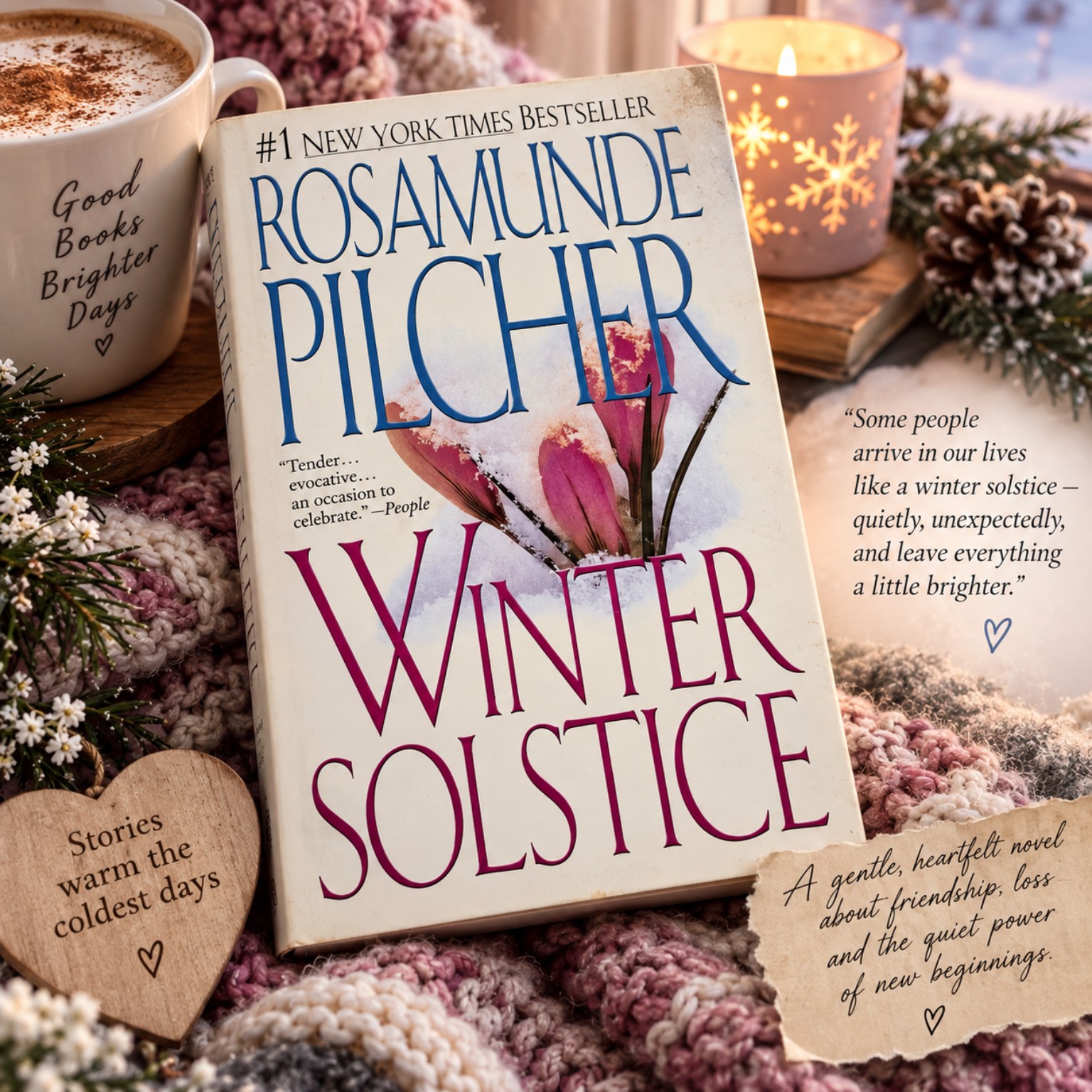
There are books you read and, once finished, stack on a shelf. Sometimes you find a book you admire. But every so often, you discover one that quietly sits beside you for a few days, reminds you to slow down, and leaves you a slightly different person. Winter Solstice is one of those books.
I chose this novel after finishing Robert Ludlum’s The Bourne Supremacy. I needed a complete change of pace—something gentle after so much tension. I was desperately in need of a palate-cleanser, and Winter Solstice didn’t disappoint.
Within the first few chapters, I noticed how Pilcher structures her novel by naming chapters after characters rather than numbering them. At first, as a new cast of people was introduced, it felt almost disorientating. Then those separate lives began to weave together—not with any fanfare, but patiently and through a natural progression.
If I had to summarise everything I learned from Rosamunde Pilcher in one sentence, it would simply be this: She is not in a hurry.
That may sound insignificant, but it isn’t. Modern novels often sprint from one event to the next, anxious to keep readers entertained, and there is nothing wrong with that. Pilcher, however, strolls. She allows people to put on coats. She notices scarves hanging on hooks. Dogs need walking. Tea needs pouring. Snow falls. People sit quietly together.
Nothing feels rushed because she understands something many writers forget: Readers don’t only fall in love with plots. They fall in love with lives. Pilcher makes ordinary moments matter.
For me, one of the most valuable writing lessons came from something incredibly simple. Take Oscar, for example. He doesn’t merely leave the house; he reaches for a borrowed muffler and enjoys the unexpected comfort it brings. He takes the dog lead from its hook. These tiny actions aren’t there to fill space—they reveal character. They allow us to inhabit Oscar’s world rather than merely observe it. As an aspiring writer, this was perhaps the biggest lesson I took from the entire novel.
Another surprise was Pilcher’s willingness to revisit events from different characters’ perspectives. Normally, I would expect repeated scenes to become repetitive. Instead, they became richer. The first chapter tells me what happened; the next tells me what it meant to someone else. That simple shift transforms repetition into emotional depth.
One scene especially stands out. For several chapters, I expected an awkward confrontation when Sam finally arrived at Creagan. Instead, everyone behaved like decent human beings. Misunderstandings were explained. Embarrassment replaced anger. Snow forced everyone to stay together.
It was wonderfully refreshing. Pilcher proves that tension doesn’t always require conflict—or someone chasing a killer across continents. Sometimes kindness is every bit as compelling.
If I had to choose my favourite character, Peter Kennedy would be very close to the top. When discussing tragedy, he rejects simplistic statements such as, “It was God’s will.” Instead, he quietly admits: “We simply don’t know enough to say that.”
Having experienced the death of my husband, I found enormous wisdom and humility in that sentence. Peter doesn’t pretend to possess certainty where certainty doesn’t exist. Ironically, that makes his faith feel more authentic.
Then there is Oscar, who gradually became the heart of the novel. Pilcher never introduces him by saying, “This is a grieving father.” Instead, she lets us discover him through everyday life.
We watch him:
- care for Lucy;
- walk the dogs;
- remember Francesca; and
- slowly learn to smile again.
Only after we have come to love him does Pilcher allow his grief to break the surface. When Lucy asks what Francesca was really good at, Oscar answers with one unforgettable word: “Living.”
I don’t think I have ever seen parental love expressed more simply or more beautifully. Later, overwhelmed by grief, Oscar apologises for crying. That tiny apology may have broken my heart even more than the tears themselves.
Throughout the novel, I began noticing Pilcher’s fingerprints as a writer. Favourite words appeared repeatedly. Her dialogue remained understated, and she trusted silence. She rarely explained emotions. Instead, she created situations in which readers experienced them naturally.
This novel became far more than enjoyable fiction. It became a masterclass, and I will forever be grateful to the author for the lessons it offered.
The lessons I will carry into my own writing include:
- Don’t hurry.
- Let ordinary actions reveal extraordinary people.
- Allow relationships to develop naturally.
- Revisit important moments through different eyes.
- Earn emotional scenes instead of forcing them.
- Sometimes one perfectly chosen word says more than an entire page.
By the final pages, accompanied by Beethoven’s “Ode to Joy,” I felt as though a camera was slowly pulling away from Creagan. There was no dramatic cliffhanger, explosion or final twist—just life continuing.
People who had been broken were no longer quite so alone, and somehow that felt like the most satisfying ending imaginable. Rosamunde Pilcher reminded me that stories don’t always need to race. Sometimes they simply need to breathe—and when they do, readers breathe with them.